One my first trip to Pine Ridge, I drove up the hill to the Wounded Knee cemetery.n the center of a standard cemetary was a chain link fence with a locked gate. I was there alone and it all looked sad, neglected, unkept and full of "trash".

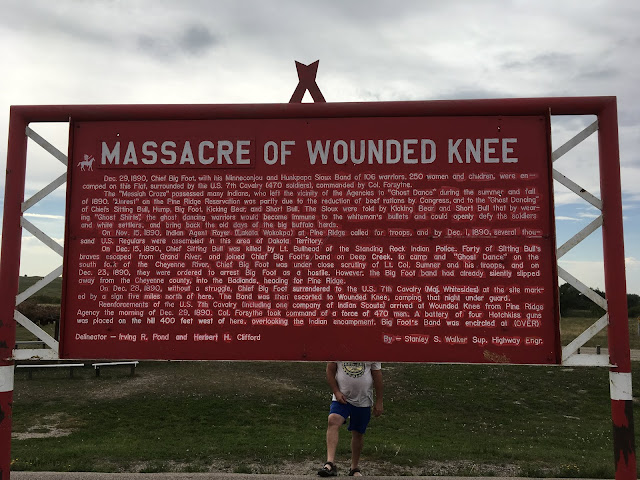
I visited the place again just a few weeks ago. It was on 9-11- the day that Americans mourn the attack that killed so many of our innocent citizens. At Wounded Knee our group stood on a grassy hill just beneath the cemetery and listened as a Lakota man pointed out where the teepee had been set up for the families. His ancestors had been escorted to that spot by the US Army.

He pointed to the bluff above the meadow where soldiers waited with four light cannons. As soldiers moved among the men to disarmed them, a deaf Lakota's weapon discharged and chaos immediately ensued. One of the few Lakota eyewitness was our guide's grandfather. As a young teen, he hid on the crest of a nearby hill and watched with his grandfather while their people were slaughtered below. From where we stood on a beautiful fall day, we looked down into the ravine where the women and children had fled. More soldiers followed and massacred them.

I visited the place again just a few weeks ago. It was on 9-11- the day that Americans mourn the attack that killed so many of our innocent citizens. At Wounded Knee our group stood on a grassy hill just beneath the cemetery and listened as a Lakota man pointed out where the teepee had been set up for the families. His ancestors had been escorted to that spot by the US Army.

He pointed to the bluff above the meadow where soldiers waited with four light cannons. As soldiers moved among the men to disarmed them, a deaf Lakota's weapon discharged and chaos immediately ensued. One of the few Lakota eyewitness was our guide's grandfather. As a young teen, he hid on the crest of a nearby hill and watched with his grandfather while their people were slaughtered below. From where we stood on a beautiful fall day, we looked down into the ravine where the women and children had fled. More soldiers followed and massacred them.

Wounded Knee is another nation's Ground Zero, this is their Pentagon and Pennsylvania field. This is where their dead lie buried in a crude, mass grave. The gate was open this time and we entered sacred ground. Sage was burnt to ask for forgiveness and purification. We stood silent as our guide prayed in Lakota and we dropped small pinches of tobacco to remind us of the sacredness of creation. Then, one by one, we filed around the mound covered with wildflowers and grasses. The fence was strung with prayer clothes, some bright, some faded. Bundles of tobacco in fabric had been left as an offering- a remembrance, a prayer for healing. A water bottle wasn't trash, it was left for the journey.


Outside the mass grave, gravestones from years ago to yesterday mark the resting places of the dead surrounded by the tufts of prairie grasses. Some are marked with red, white and blue. These American flags are on graves of those who had served in the United States military.
Native Americans serve this country at the highest per-capita rate of all the races in the US.

There are no fancy, expensive interpretive sites here. There isn't the manicured lawn of Arlington or a solemn soldier standing guard over the Grave of the Unknown Soldier. A non-native eye would dismissed the old cemetery, as I first did. But here lie the finest native warriors and chiefs the Army ever faced. Chiefs who in desperation brought their women and children to the meeting fields for peace talks and were mowed down by superior military weapons, not by superior men. The white soldiers weren't content to use greater firepower- they chased down the women and children and used bayonets on them as well.
One infant was found under her mother and anArmy officer claimed her as a war prize. He displayed her as a savage and she died at a young age after what must have been a gruesome life. http://americanindiansandfriends.com/main-feed-news/lost-bird-the-sad-story-of-a-baby-taken-from-wounded-knee
One infant was found under her mother and anArmy officer claimed her as a war prize. He displayed her as a savage and she died at a young age after what must have been a gruesome life. http://americanindiansandfriends.com/main-feed-news/lost-bird-the-sad-story-of-a-baby-taken-from-wounded-knee
We humans build monuments to remember our dead,
we need to remember the stories that make up our identity.
Most Americans would be up in arms if Al Qaeda or Isis told us to "get over the past, move on, 9-11 happened a long time ago". And many white Americans do consider the atrocities committed against the previous residents of this country as a long time ago. After all, they lost the war. We say if not with words, with attitude- " Move on, forget the past, get an education, make something of yourself, follow the American dream."
The attackers, the oppressors don't get to say when the victims or the oppressed
have had enough, have healed, have moved on.
That's not he right of the "victors".
The victims get to make the memorials and the pilgrimages.
They get to say when their wounds are healed.

After 9-11, most Americans were shaken to the core but still alive. Most were able to return to their new normal or start new lives. But we still remember. If we compare what happened to us as a nation on that day to the years of interaction with First Peoples, we weren't subjugated, starved, or stripped of our children, our language or culture. Our children weren't forcibly removed to boarding schools- many who never saw family again. We weren't sold alcohol that subdued our spirits but released our rage. We weren't given handouts for so long we didn't know how to live as free people.
In this month, for me, the breaking of a nation's spirit didn't feel so long ago. As I drove past dilapidated trailers that speaks of the worst poverty in America, I felt despair. It didn't feel like a healed nation as its ragged children played outside in the dirt and junk cars. It didn't feel like ancient history when you learn 80% of the current Lakota population still isn't employed. And due to the complicated land policies set up by the conquerors, industry can't come in to build commercial infrastructure. Lakota people can rarely build or own houses since they don't own their own land. According to some records, no one expected the natives to survive the reservation experiment so plans weren't made for the generations to come. Or even worse....
(A)young newspaper editor L. Frank Baum, later the author of The Wonderful Wizard of Oz, wrote in the Aberdeen Saturday Pioneer on January 3, 1891:
I know much good has been done on Pine Ridge and I know many of my fellow South Dakotans have tried and been disappointed in their attempts to help. I know my words may not make a difference but I need to say them for my own witness. What did make a difference for me in how I viewed Wounded Knee this time.
His grandfather witnessed this massacre happened. This is part of his family story. This is his 9-11. This is a story I want to respect and honor and witness to the truth of what one nation, my nation did to another.

(A)young newspaper editor L. Frank Baum, later the author of The Wonderful Wizard of Oz, wrote in the Aberdeen Saturday Pioneer on January 3, 1891:
I know much good has been done on Pine Ridge and I know many of my fellow South Dakotans have tried and been disappointed in their attempts to help. I know my words may not make a difference but I need to say them for my own witness. What did make a difference for me in how I viewed Wounded Knee this time.
This time I visited with a man for whom this isn't ancient history.
His grandfather witnessed this massacre happened. This is part of his family story. This is his 9-11. This is a story I want to respect and honor and witness to the truth of what one nation, my nation did to another.
Forgive us, help us forgive ourselves
and may we all move forward
in wisdom and mercy.


